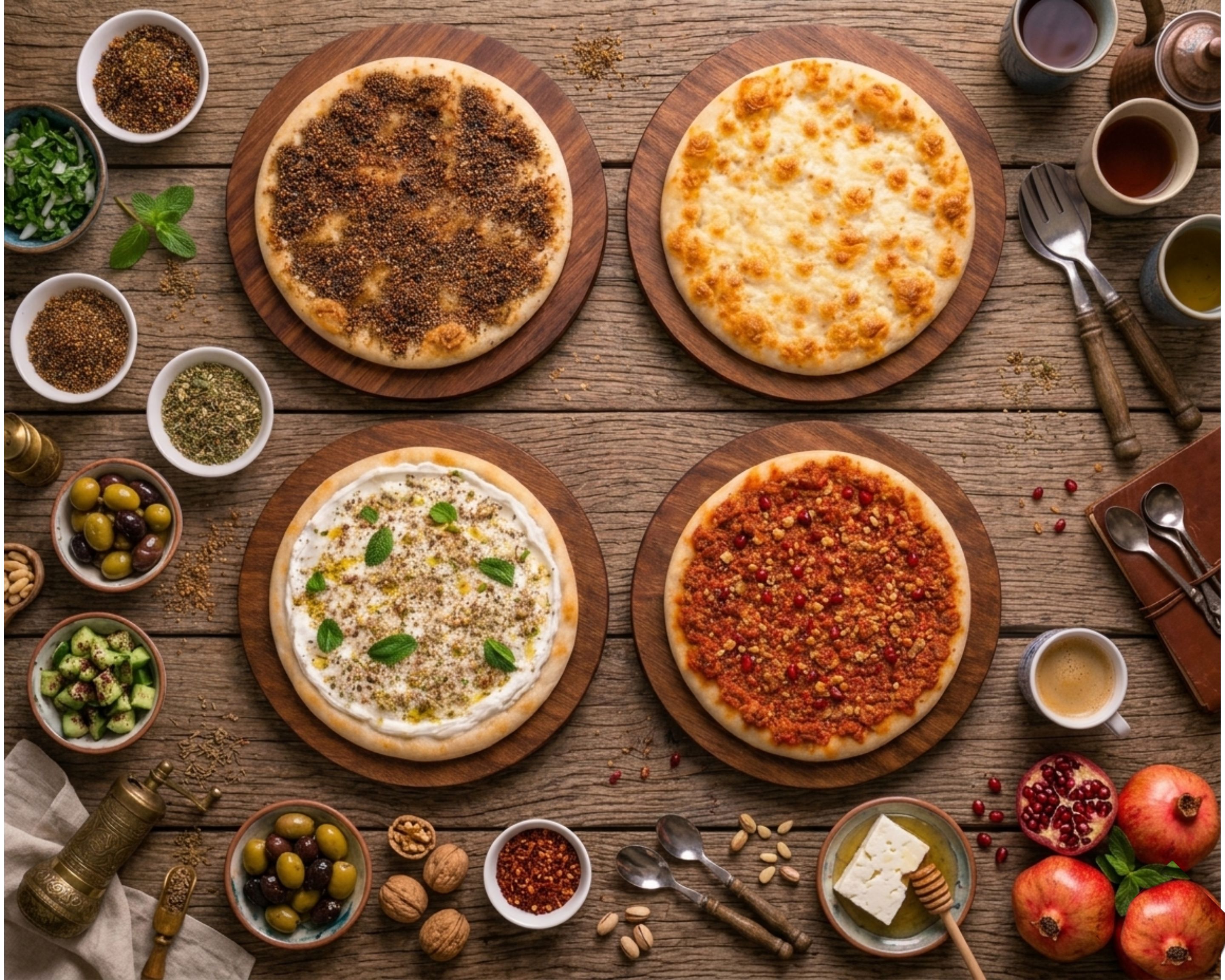
Manakish — also written manakeesh, manaqish, or manoushe — is a Levantine flatbread topped before baking with zaatar and olive oil, melting cheese, spiced minced meat, or a handful of other classics. It is the everyday breakfast bread of Lebanon, Syria, Palestine and Jordan: cheap, fast, eaten hot, and sold from neighbourhood ovens that have been running since before dawn.
If you have walked past our bakery counter in Milton in the morning, that smell of thyme and hot olive oil is manakish coming out of the oven.
Where manakish comes from
The word comes from the Arabic naqasha, meaning to carve or engrave — a reference to the dimples pressed into the dough with the fingertips before the topping goes on. Those dimples are not decorative. They hold the oil and stop the bread from ballooning in the oven.
Historically, families made the dough at home and carried the trays to the shared village oven, the furn, to be baked. The baker charged a few coins per tray. In much of the Levant this is still how Friday mornings work, and it is why manakish is tied so closely to the idea of a neighbourhood rather than a restaurant.
What goes on top
Zaatar
The original and still the most common. Zaatar is a blend of dried wild thyme, sumac, toasted sesame seeds and salt, loosened with a generous pour of olive oil into a loose paste. It bakes into something herbal, tangy and slightly bitter, and it is the benchmark by which any bakery is judged. Good zaatar manakish is about the quality of the oil as much as the herb blend.
Cheese (jibneh)
Traditionally akkawi, a mild white brine cheese that is soaked to draw out the salt, then shredded so it melts into long pulls with brown blistered spots. Some bakeries cut it with mozzarella for stretch. Eaten folded in half, straight from the counter.
Meat (lahm bi ajeen)
Minced beef or lamb mixed with finely chopped tomato, onion, pepper paste and seven-spice, spread thin so it cooks down into the dough rather than sitting on it. A squeeze of lemon at the table is not optional. This is the Armenian-influenced version common in Aleppo and Beirut alike.
Spinach (fatayer sabanekh)
Spinach wilted with onion, sumac and lemon juice, then enclosed in dough and folded into a triangle. Technically a fatayer rather than a flat manoushe, but every manakish bakery sells them and they are almost always vegan.
Muhammara, keshek, and the rest
Regional favourites fill out the board: muhammara (roasted red pepper and walnut), keshek (fermented yogurt and bulgur), labneh with mint and olives, and sweet versions with nutella or halawa for children. At our bakery, muhammara and nutella are the two that surprise people most.
How it is baked
Manakish dough is a simple yeasted bread dough — flour, water, yeast, salt, a little olive oil and often a spoon of sugar to help the crust colour. What matters is the rest. Dough that has proofed slowly is soft and pliable rather than tough, and it bakes in a matter of minutes.
The bake is short and hot: three to six minutes on a stone or in a deck oven at roughly 260–300°C (500–570°F). The edges puff and crisp while the middle stays soft enough to roll. Any longer and you have a cracker. This is why manakish is baked to order and why buying it hot matters more than it does with most breads.
How to eat manakish
- Roll it. Zaatar manakish is rolled into a cylinder, not sliced. Cheese is folded in half.
- Add fresh things. Mint leaves, sliced tomato, cucumber, olives and pickled turnip are all standard additions, tucked in before rolling.
- Drink tea or ayran with it. Sweet black tea in the morning; salted yogurt drink with the meat version.
- Eat it hot. Manakish is not a make-ahead food. It is at its best within twenty minutes of the oven.
Manakish vs. pizza
People reach for the pizza comparison and it is not wrong, but the differences matter. Manakish dough is thinner and softer, with no raised cornicione. The traditional topping is a herb-and-oil paste rather than tomato sauce and mozzarella. The bake is shorter. And the whole thing is built around breakfast rather than dinner — a manakish is what you eat at 8 AM on your way somewhere.
Making it at home
It is genuinely easy, and the only hard part is sourcing a good zaatar blend. A basic version:
- Make a soft yeasted dough and let it rise until doubled — about 90 minutes.
- Divide into balls roughly the size of a lemon, cover, and rest another 20 minutes.
- Roll or press each into a disc about 20 cm across and dimple it with your fingertips.
- Mix zaatar with olive oil until it is a spreadable paste — roughly two parts zaatar to one part oil — and spread it right to the edge.
- Bake on a preheated stone or upturned tray at your oven's highest setting, 6–8 minutes, until the base is set and lightly coloured.
Every ingredient — zaatar blends, sumac, extra virgin olive oil, akkawi cheese, pepper paste — is on our grocery shelves in Milton. And if you would rather skip the two hours of proofing, our bakery is open Tuesday to Sunday from 9:00 AM to 7:00 PM — closed Mondays — and you can order by phone at (905) 878-4567 or on Uber Eats.
Frequently asked questions
Is manakish the same as manakeesh?
Yes. Manakish, manakeesh, manaqish and mana'eesh are all transliterations of the same Arabic word. Manoushe is the singular form, common in Lebanon.
Is manakish healthy?
Zaatar manakish is bread, olive oil and herbs — thyme and sumac both carry antioxidants, and olive oil is the fat. It is a reasonable breakfast. Cheese and meat versions are heavier, as you would expect.
Is manakish vegan?
Zaatar and spinach manakish usually are, as long as the dough contains no dairy. Cheese, labneh and nutella versions are not.
Can manakish be frozen?
Yes. Cool it fully, wrap tightly, and freeze for up to a month. Reheat from frozen in a 180°C oven for 6–8 minutes. Avoid the microwave, which turns the dough leathery.
Where can I buy manakish in Milton?
TB Bakery inside Tomatoes Bazar, Unit 4–5, 700 Nipissing Rd, bakes manakish fresh Tuesday to Sunday from 9:00 AM to 7:00 PM — closed Mondays — with a different flavour on special each day starting at $3.99. Order by phone at (905) 878-4567 or on Uber Eats.